
Is Pilates “Enough” Strength Training? It Depends — and That’s Okay.
Pilates is often misunderstood in conversations about strength training. This article explores where Pilates truly fits within a strength-based framework, clarifying its benefits for isometric strength, movement control, and confidence-building—especially for those hesitant to lift heavy. Learn how Pilates supports long-term strength development, complements gym training, and serves as a powerful foundation for building resilient, capable bodies.
1/13/20266 min read

If you’ve spent any time around strength-training discussions lately, you’ve probably heard claims like:
“Pilates isn’t real strength training.”
“It doesn’t build muscle or strong bones.”
So where does Pilates actually fit — and is it worth your time?
I’ve sat on both sides of the fence over the course of my career, and honestly, I still do — because the short answer is: yes, it’s worthwhile, but it serves a different purpose than traditional gym-based strength training. When clients, especially those concerned with building healthy movement patterns for longevity, ask me, I explain the difference objectively, and it usually clears up a lot of confusion.
Pilates Builds a Different Kind of Strength
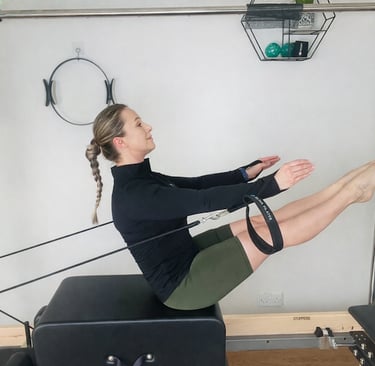
Strength isn’t just about how much weight you can lift. Pilates develops strength endurance — the ability to hold and control positions under fatigue — and we then work on isometric strength, sometimes under load on the reformer or using bands and small weights. These are forces produced without joint movement, which is a unique quality not always captured in gym metrics.
Research shows that Pilates programs can produce meaningful improvements in strength measures like handgrip and core endurance, particularly in older adults and clinical populations. For example, one 12-week Pilates intervention showed statistically significant gains in upper body, lower body, and abdominal strength in post-menopausal women. Another study in women over 60 found improvements in handgrip strength and gait speed after a Pilates program.
Pilates also targets motor control and coordination, helping muscles work together efficiently — teaching how to dissociate the hip from the spine, how to build low-back and pelvic stability, and how to enhance body awareness (or proprioception). These qualities matter for daily life, injury prevention, and long-term joint health. They are indeed real strength attributes, even if they don’t show up on a barbell.
Why Pilates Feels “Easier” — But Isn’t
In our quest to achieve these outcomes, we often use bodyweight on the mat, a range of spring-loaded tension on the reformer and Cadillac, progress to long levers, slow controlled movement, and sustained holds. While it may look gentle, these conditions create significant muscular demand, particularly for stabilising muscles and neuromuscular control.
Some meta-analyses suggest Pilates produces smaller improvements in maximal strength compared to traditional resistance training, particularly in older adults. However, improvements in muscular endurance, balance, and functional performance are more consistently reported. Evidence quality is still evolving, but the pattern is clear: the adaptation is different.
So the challenge is different, not absent. Pilates usually doesn’t expose the body to very high external loads — and that’s where much of the criticism comes from. Without progressive overload (adding meaningful load over time), large increases in muscle size and bone density tend to be limited.
What Pilates Is Not Designed to Maximise
IIt’s fair to say that Pilates is not the most efficient tool for maximal muscle hypertrophy or maximal bone density gains, especially in the hips and spine.
Muscle growth can occur with lower loads when exercises are performed close to muscular fatigue. However, traditional higher-load resistance training generally provides a more time-efficient and reliable stimulus for significant hypertrophy.
Bone tissue responds best to high strain and impact forces. Because Pilates is typically low-impact and moderate load, it may help maintain bone health but is unlikely to provide the same osteogenic stimulus as heavy lifting or jumping-based exercise.
Pilates may provide enough resistance to stimulate muscle growth and support bone health, particularly with heavy springs or long-lever positions, but current research has not yet definitively quantified these effects. By contrast, higher-load resistance training and impact exercise have a stronger evidence base for reliably producing hypertrophy and bone density improvements.
Current resistance training guidelines from organizations such as the American College of Sports Medicine recommend moderate to high-load resistance training, and impact-based activity where appropriate, for optimal muscle and bone adaptations.
But this doesn’t make Pilates ineffective — it simply means it serves a different role.
For many people (supported by both research and client experience), Pilates offers a uniquely accessible entry point into structured strength work. While much of the research has focused on women, the benefits extend across populations — including men who use Pilates to improve lifting mechanics, trunk stability, and movement efficiency.
More accessible than a traditional gym,
Less intimidating,
A safer-feeling option during recovery, postpartum, or after injury,
A way to build confidence and consistency with movement,
A structured way to introduce meaningful resistance and muscular fatigue — without immediately jumping to maximal loads.
Pilates offers a guided entry point into resistance training. Programming is done for you, resistance can be increased in small, manageable increments using spring tension, and continuous cueing ensures movement quality is maintained throughout.
I’d also emphasise something often overlooked: Pilates is enjoyable, and anything you enjoy enough to show up for week after week is a huge win. Because the best exercise program is the one you actually stick to.
What Pilates Helps People Do
Pilates helps people:
Learn how to move well with control and intention,
Build baseline strength and endurance,
Improve body awareness and proprioception,
Develop the foundation needed to lift heavier later — if they choose to.
While stronger muscles do place more load on bones, bone adaptation depends on the magnitude and speed of force. Not all increases in muscle strength automatically translate into significant bone density changes.
For many, Pilates isn’t the end goal — it’s the foundation.
Pilates and the Gym Don’t Compete — They Complement
The strongest, most resilient bodies often combine both. Pilates supports better lifting technique, improved trunk stability, reduced injury risk, and longevity in training.
Many clients who play team sports, or engage in running, cycling, swimming, or heavy lifting, come to Pilates to fill in the movement quality gaps: to reconnect with their bodies, enhance flexibility, build resilience, and support long-term training consistency.
They go to the gym to build muscle, maximise bone health, and increase performance outputs. Together, these approaches cover far more ground than either does alone.
Movement Quality Matters Too
We’re often told Pilates only works in the sagittal plane (forward and backward movement), but anyone who regularly attends class knows that’s far from the truth.
Contemporary Pilates programming incorporates sagittal, frontal, and transverse plane movement, challenging rotation, side bending, and multiplanar coordination — qualities highly relevant to real-life movement demands.
Pilates improves motor control, coordination, breathing mechanics, postural endurance, and balance — all of which contribute to long-term musculoskeletal health alongside hypertrophy and bone density outcomes.
The Bottom Line
Pilates is strength training — just not the kind measured by max lifts. It builds control, endurance, coordination, confidence, and sustainable movement habits.
For some, that’s enough.
For others, it’s the perfect stepping stone toward heavier training.
Strength isn’t one thing, and Pilates absolutely earns its place in the conversation.
Some research suggests Pilates may improve strength and functional fitness, but current studies on Pilates and bone mineral density or direct muscle hypertrophy outcomes are limited, mixed, and generally low in methodological quality. In contrast, high‑load resistance training and impact exercise have much stronger evidence for reliably increasing bone density and muscle size.
To sum it up: Pilates is excellent for building movement competence and strength endurance. For maximal muscle growth and bone density, additional progressive resistance or impact loading is required. It doesn’t make one superior to the other — they can and should co-exist in the movement ecosystem.
See you in class!
Alice
References
Peer Reviewed Research
González-Gálvez N, Sainz de Baranda P, et al. Effects of a 12-week Pilates program on muscle strength and endurance in women. Journal of Strength and Conditioning Research. https://pmc.ncbi.nlm.nih.gov/articles/PMC5005852/
Rodríguez-Ferrer ME, et al. Effects of Pilates training on muscle strength and gait speed in older adult women. Journal of Aging and Physical Activity. https://pubmed.ncbi.nlm.nih.gov/32991508/
(Systematic Review) Effects of Pilates on muscular strength and endurance in older adults: A systematic review and meta-analysis. https://pubmed.ncbi.nlm.nih.gov/38876695/
American College of Sports Medicine. Progression Models in Resistance Training for Healthy Adults. Medicine & Science in Sports & Exercise (2009). https://pubmed.ncbi.nlm.nih.gov/19204579/
Meet your Author:
Alice is a seasoned Pilates instructor with 20 years of experience in the fitness and wellness industry in Ireland. Certified by Balanced Body as a Comprehensive Pilates Instructor, she also holds qualifications as an NTC Personal Trainer and Exercise and Health Coach. Based in Westport, Co Mayo, Ireland. Alice teaches Reformer and Mat Pilates classes, and offers private equipment-based sessions using the Reformer, Cadillac, and other apparatus. She works with a wide range of clients, tailoring programs to individual needs — from office workers and recreational athletes. Before specializing in Pilates, Alice spent over a decade managing fitness facilities, giving her a broad understanding of both client care and the evolving fitness industry. Today, she brings that expertise to her teaching — offering a thoughtful, structured, and progressive approach to Pilates that meets clients exactly where they are.
Alice is passionate about helping people move well and move smart. Whether you're practicing at home or in the studio, her goal is to help you build a strong foundation, avoid compensation, and experience how Pilates can truly support your everyday life.
Learn to move well. For life.
© 2026 Unified Pilates. All rights reserved.

